

Ekmel Çilingir: Stablecoins Are Outpacing CBDCs in the Race for Digital Money Adoption
Ekmel Çilingir: Stablecoins Are Outpacing CBDCs in the Race for Digital Money Adoption
Ekmel Çilingir: Stablecoins Are Outpacing CBDCs in the Race for Digital Money Adoption
People did not wait for a national CBDC to access digital money”
VILNIUS, LITHUANIA, July 8, 2026 /EINPresswire.com/ -- Ekmel Çilingir, Chairman of the Supervisory Board at EMBank, has recently published a new thought leadership article examining why USD-backed stablecoins are gaining practical adoption faster than central bank digital currencies, or CBDCs, despite years of public-sector planning.— Ekmel Cilingir, Chairman of the Supervisory Board at EMBank
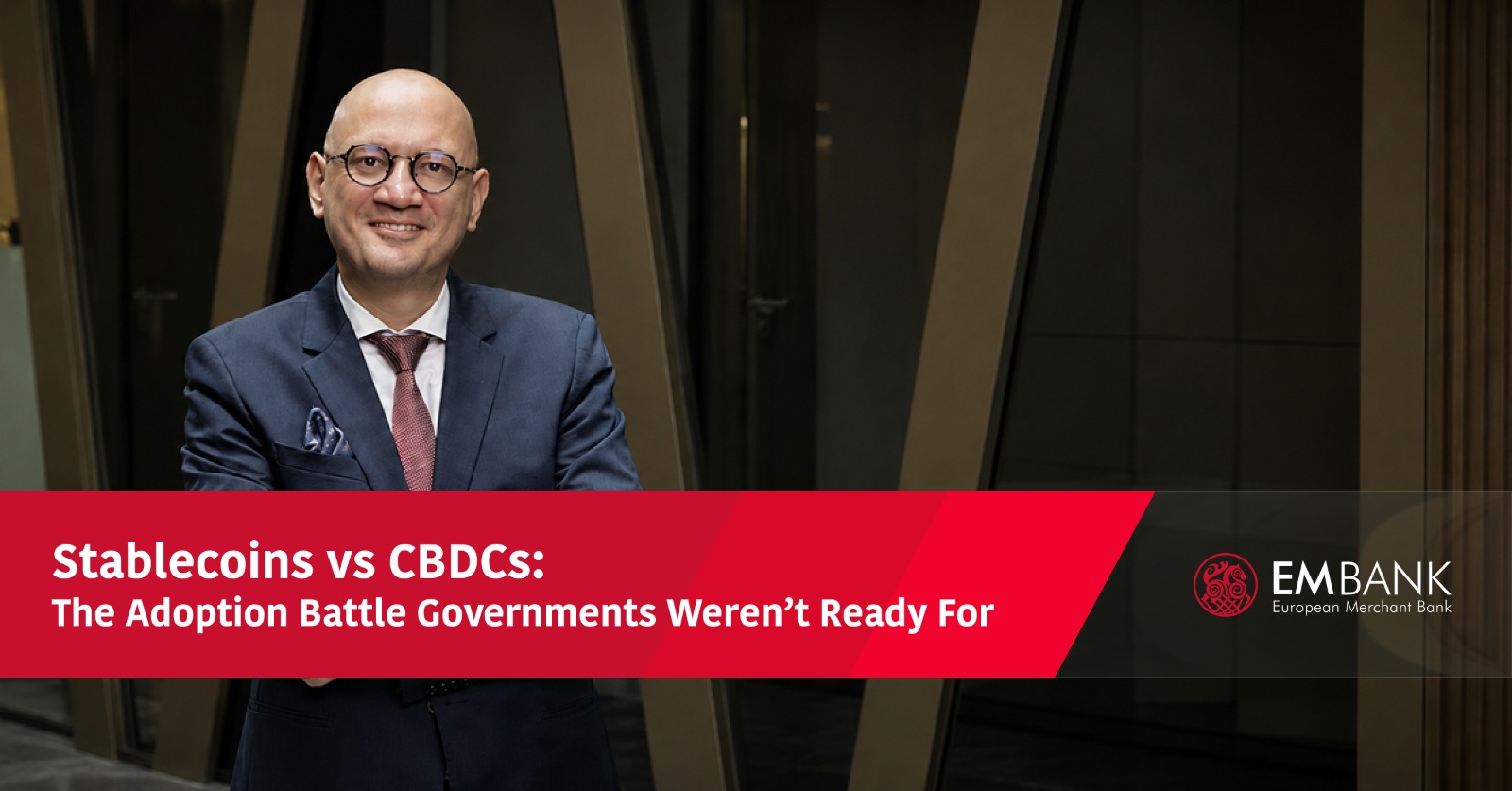
In the article “Stablecoins vs CBDCs: The Adoption Battle Governments Weren’t Ready For,” Çilingir argues that the future of digital money is being shaped less by official design and more by user demand. While central banks have spent years assessing CBDCs through pilots, consultations and policy debates, stablecoins have become widely used because they address immediate financial needs.
“People did not wait for a national CBDC to access digital money,” Çilingir writes. “In many markets, especially emerging ones, they adopted stablecoins because stablecoins solved an immediate problem: access to dollars, faster cross-border transfers, lower friction in digital commerce and protection against unstable local currencies.”
Çilingir frames the issue as a contest between government-designed digital money and market-distributed digital dollars. He notes that CBDCs were developed to modernise money, support faster payments, reduce cash-handling costs, improve public transfers and protect monetary sovereignty. Yet, in many cases, they have struggled to answer a simple user question: why should I use this?
By contrast, stablecoins have gained ground by meeting clear market needs. USD-backed tokens can move across borders, operate outside banking hours, connect with wallets and exchanges, and offer digital dollar access without a traditional US dollar bank account.
“Stablecoins are winning for a simple reason: they solve real problems,” Çilingir writes.
The article places special emphasis on emerging markets, where inflation, currency depreciation, capital controls, costly remittances and limited access to global banking have made digital dollars attractive. For freelancers, exporters, merchants and households, stablecoins can provide a practical tool for payment, settlement or savings.
Çilingir also argues that this trend should be understood as digital dollarisation rather than de-dollarisation. “The market did not choose Bitcoin as everyday money, and it did not choose a neutral global currency. It chose tokenised dollars,” he writes.
According to the article, stablecoin supply is to reach roughly $320 billion by 2026, with Tether’s USDT near $190 billion and Circle’s USDC around $78 billion. Çilingir notes that not all stablecoin transaction volume reflects ordinary payments, as much of it comes from trading and institutional settlement. Even so, he argues that the on-chain dollar has already become a significant settlement layer.
The article also examines regulation. Çilingir writes that governments are now bringing stablecoins within formal regulatory frameworks, including the GENIUS Act in the United States and MiCA in the European Union. In his view, stronger regulation may not weaken stablecoins. It may make them more legitimate.
“The more seriously governments regulate stablecoins, the more legitimate they become,” Çilingir writes. “What was once treated as a crypto experiment is turning into an accepted layer of the financial system.”
For banks, fintechs and payment companies, Çilingir sees both risk and opportunity. Stablecoins can pressure traditional cross-border payment rails, especially where existing systems remain slow, costly or limited by banking hours. At the same time, regulated financial institutions may use stablecoin infrastructure for custody, treasury, settlement, remittances, merchant payments and tokenised deposits.
Çilingir concludes that stablecoins should no longer be treated only as crypto products but as an emerging payment infrastructure. “The winners will be the institutions that combine the speed and openness of new rails with the trust, compliance and risk management of regulated finance,” he writes.
The full article is available here.
Dilek Işık
European Merchant Bank (EMBank)
email us here
Legal Disclaimer:
EIN Presswire provides this news content "as is" without warranty of any kind. We do not accept any responsibility or liability for the accuracy, content, images, videos, licenses, completeness, legality, or reliability of the information contained in this article. If you have any complaints or copyright issues related to this article, kindly contact the author above.
